COLOMBO, Sri Lanka – Volunteers dug mass graves in the marshes of Sri Lanka's northern war zone Monday as they buried hundreds of civilians killed in artillery attacks that the U.N. characterized as a "bloodbath."
A doctor in the war zone said as many as 1,000 civilians may have been killed in two days of shelling that marked some of the worst violence in this Indian Ocean island nation since the civil war flared up again more than three years ago.
With the civilian death toll skyrocketing, the Tamil Tiger rebels and a coalition of international human rights groups separately called for the U.N. Security Council to urgently hold talks on the conflict. But with several nations protesting such talks, that seemed unlikely.
The government and the separatist rebels both denied responsibility for the artillery attacks that struck the tiny sliver of northeast coast still held by the rebels in two waves. The worst barrage pounded the area, which holds an estimated 50,000 trapped civilians, from Saturday night until Sunday morning, health officials said.
Another attack hit the area overnight Sunday, landing in a newly demarcated "safe zone" where the government had urged civilians to gather, according to Dr. V. Shanmugarajah, who works at a makeshift hospital in the area.
A total of 430 ethnic Tamil civilians, including 106 children, were either brought to the hospital for burial or died at the facility, he said. More than 1,300 wounded came to the hospital as well, he said. But, he said, the death toll was likely far higher because many of those killed would have been buried in the bunkers where they were slain, and many of the gravely wounded never made it to the hospital for treatment. "There were many who died without medical attention," Shanmugarajah said. "Seeing the number of wounded, and from what the people tell me, I estimate the death toll to be around 1,000."
Volunteers dug mass graves in the marsh near the hospital, putting 50 to 60 bodies in each pit, he said. One of the hospital's nurses was killed along with his family as they sheltered from the onslaught in a trench that was then filled with soil and turned into their grave, he said. "The U.N. has consistently warned against the bloodbath scenario as we've watched the steady increase in civilian deaths over the last few months," U.N. spokesman Gordon Weiss said. "The large-scale killing of civilians over the weekend, including the deaths of more than 100 children, shows that that bloodbath has become a reality."
In Washington, State Department spokesman Ian Kelly expressed deep concern.
"We think that there's an unacceptably high level of civilian casualties," he told reporters. The hospital in the war zone was so overwhelmed that many of those wounded in Saturday's barrage had still not been treated Monday morning. Every time Shanmugarajah left the operating room, he was mobbed by those seeking treatment, he said. "The hospital death rate is increasing, but we are helpless," he said.
People were begging the doctors to send them away on a Red Cross ship that comes every few days to evacuate the wounded, saying they could not bear the shelling anymore, he said.
Reports of the fighting are difficult to verify because the government bars journalists and aid workers from the war zone.
U.N. figures compiled last month showed that nearly 6,500 civilians had been killed in three months this year as the government drove the separatist rebels from their northern strongholds and vowed to end the war.
Selvarasa Pathmanathan, a top rebel official, appealed to the international community and the Security Council to take up the war "as a matter of urgency," according to a statement posted on the rebel-linked Web site TamilNet.
Human Rights Watch, Amnesty International and other rights groups called on Japan, the largest international donor to Sri Lanka, to press the U.N. to urgently address the war, and British Foreign Secretary David Miliband called for discussions to be held at all levels of the U.N. on the plight of the civilians. "No one can be in any doubt that this is an issue that deserves the international community's attention," Miliband told reporters at U.N. headquarters in New York. Sri Lanka is not on the Security Council agenda because Russia, China, Japan and Vietnam consider the fighting an internal matter.
The rebels, listed as a terror group by the U.S. and the EU, blamed the artillery assaults on the government, with Pathmanathan calling them "a deliberate massacre of Tamil civilians by the Sri Lankan armed forces. "Human Rights Minister Mahinda Samarasinghe denied the government was responsible for any artillery attacks and claimed health officials in the area were under pressure from the rebels to lie. "We have consciously avoided firing into the areas where civilians are forcibly held by the LTTE," he said, referring to the rebels by the acronym of their formal name, the Liberation Tigers of Tamil Eelam.
Rights groups have accused the government of bombing and shelling the war zone despite pledges to stop using heavy weapons, and accuse the rebels of holding civilians as human shields and shooting at many who tried to flee. The government has brushed off international calls for a humanitarian truce, saying any pause in the fighting would give the rebels time to regroup and prolong a war that has already lasted more than a quarter century.
___
Associated Press writers Krishan Francis and Bharatha Mallawarachi contributed to this report from Colombo and Edith Lederer contributed from the United Nations.
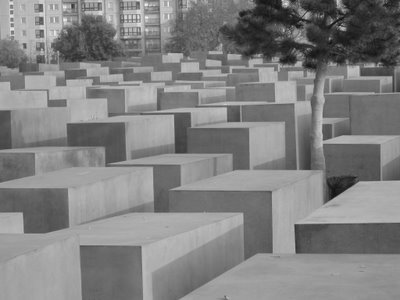
Holocaust Memorial Berlin
Tuesday, May 12, 2009


Wednesday, April 22, 2009
Global Economics and Earth Day: We Just Don't Get It!
It's Earth Day today, a time when we are supposed to appreciate our environment, and do things that save rather than destroy the planet. I commend those who are actively involved in all endeavours associated with Earth Day, and admire the commitment of people who make Earth Day an everyday event...
With that being said, I find it laughable that we have global "leaders" who will on one hand talk about the need to save our planet, but on the other, encourage people to continue their consumer habits in order to support "positive" growth. This global economic framework is no longer valid!!!!!!!! It is, simply put, a model built on greed...Growth is monetary and quantitative, we need to focus on a development model which supports qualitative aspects associated with social and environmental betterment.
The Current Economic Growth and Greed model:
-allows places like Dubai to build out of control in order to guarantee that the rich are kept luxuriously ignorant of its unsustainable future...a shopping mall with a ski resort (in a city that hits 50 degrees in the summer)?!...Housing developments built on man-made islands in the shape of the world (by the way they're sinking and because of the dredging, have completed altered the aquatic ecosystems in the area)?!
-gives Beijing the right to tear down long-established Hutong (cultural) communities to make way for progress in the form of sports facilities and shopping malls...industry is also running rampant under its new economic policies (the sky is permantly grey from the pollution)!
-helps support sub-Saharan Africa's downward spiral into poverty from which it can never hope to recover (and due to this poverty, gives no choice to people but to actively degrade their environments further).
-supplies status and wealth to followers, who as loyal subjects are sometimes afforded the freedom to marginalize and suppress others in order to further support the model.
The list goes on, and I will stop my rant there before I begin on my own country (tar sands in northern Alberta???).
Happy Earth Day everyone!
T
Wednesday, February 25, 2009
Better Late Than Never
I forgot to post this note on February 20th...that day marked "The (first) World Day for Social Justice" as proclaimed by the UN General Assembly.
As recognized by the World Summit, social development aims at social justice, solidarity, harmony and equality within and among countries and social justice, equality and equity constitute the fundamental values of all societies. To achieve “a society for all” governments made a commitment to the creation of a framework for action to promote social justice at national, regional and international levels. They also pledged to promote the equitable distribution of income and greater access to resources through equity and equality and opportunity for all. The governments recognized as well that economic growth should promote equity and social justice and that “a society for all” must be based on social justice and respect for all human rights and fundamental freedoms.
http://un.org/esa/socdev/social/intldays/IntlJustice/
Something to Be Positive About
Johanna Sigurdardottir, named as Iceland's prime minister on Sunday, is the first openly lesbian head of government in Europe, if not the world - at least in modern times. The 66-year-old's appointment as an interim leader, until elections in May, is seen by many as a milestone for the gay and lesbian movement.
Up until now, if a gay man or woman has been prime minister, they have done their best to conceal the fact. In Iceland itself, however, the new prime minister's sexual orientation appears to be causing less excitement than it is abroad.
What is really historic about this new cabinet, says Skuli Helgeson, the general secretary of Ms Sigurardottir's Social Democratic Alliance, is not the fact that its leader is a lesbian, but that for the first time in Icelandic history it boasts an equal number of men and women.
http://news.bbc.co.uk/2/hi/europe/7862804.stm
Friday, January 9, 2009
UN Addresses Sexual Orientation and Gender Identity
Courtesy IGLHRC:
(New York, December 11, 2008) - As the world celebrates the 60th anniversary of the Universal Declaration of Human Rights (UDHR), the UN General Assembly will hear a statement in mid-December endorsed by more than 50 countries across the globe calling for an end to rights abuses based on sexual orientation and gender identity. A coalition of international human rights organizations today urged all the world's nations to support the statement in affirmation of the UDHR's basic promise: that human rights apply to everyone.
Nations on four continents are coordinating the statement, including: Argentina, Brazil, Croatia, France, Gabon, Japan, the Netherlands, and Norway. The reading of the statement will be the first time the General Assembly has formally addressed rights violations based on sexual orientation and gender identity.
"In 1948 the world's nations set forth the promise of human rights, but six decades later, the promise is unfulfilled for many," said Linda Baumann of Namibia, a board member of Pan Africa ILGA, a coalition of over 60 African lesbian, gay, bisexual, and transgender (LGBT) groups. "The unprecedented African support for this statement sends a message that abuses against LGBT people are unacceptable anywhere, ever."
The statement is non-binding, and reaffirms existing protections for human rights in international law. It builds on a previous joint statement supported by 54 countries, which Norway delivered at the UN Human Rights Council in 2006.
"Universal means universal, and there are no exceptions," said Boris Dittrich of the Netherlands, advocacy director of Human Rights Watch's lesbian, gay, bisexual, and transgender rights program. "The UN must speak forcefully against violence and prejudice, because there is no room for half measures where human rights are concerned."
The draft statement condemns violence, harassment, discrimination, exclusion, stigmatization, and prejudice based on sexual orientation and gender identity. It also condemns killings and executions, torture, arbitrary arrest, and deprivation of economic, social, and cultural rights on those grounds.
"Today, dozens of countries still criminalize consensual homosexual conduct, laws that are often relics of colonial rule," said Grace Poore of Malaysia, who works with the International Gay and Lesbian Human Rights Commission. "This statement shows a growing global consensus that such abusive laws have outlived their time."
The statement also builds on a long record of UN action to defend the rights of lesbian, gay, bisexual, and transgender people. In its 1994 decision in Toonen v. Australia, the UN Human Rights Committee - the body that interprets the International Covenant on Civil and Political Rights (ICCPR), one of the UN's core human rights treaties - held that human rights law prohibits discrimination based on sexual orientation. Since then, the United Nations' human rights mechanisms have condemned violations based on sexual orientation and gender identity, including killings, torture, rape, violence, disappearances, and discrimination in many areas of life. UN treaty bodies have called on states to end discrimination in law and policy.
Other international bodies have also opposed violence and discrimination against LGBT people, including the Council of Europe and the European Union. In 2008, all 34 member countries of the Organization of American States unanimously approved a declaration affirming that human rights protections extend to sexual orientation and gender identity.
"Latin American governments are helping lead the way as champions of equality and supporters of this statement," said Gloria Careaga Perez of Mexico, co-secretary general of ILGA. "Today a global movement supports the rights of lesbian, gay, bisexual, and transgender people, and those voices will not be denied."
So far, 55 countries have signed onto the General Assembly statement, including: Andorra, Armenia, Australia, Bosnia and Herzegovina, Canada, Cape Verde, the Central African Republic, Chile, Ecuador, Georgia, Iceland, Israel, Japan, Liechtenstein, Mexico, Montenegro, New Zealand, San Marino, Serbia, Switzerland, the Former Yugoslav Republic of Macedonia, Uruguay, and Venezuela. All 27 member states of the European Union are also signatories.
"It is a great achievement that this initiative has made it to the level of the General Assembly," said Louis-Georges Tin of France, president of the International Committee for IDAHO (International Day against Homophobia), a network of activists and groups campaigning for decriminalization of homosexual conduct. "It shows our common struggles are successful and should be reinforced."
"This statement has found support from states and civil society in every region of the world," said Kim Vance of Canada, co-director of ARC International. "In December a simple message will rise from the General Assembly: the Universal Declaration of Human Rights is truly universal."
The coalition of international human rights organizations that issued this statement include: Amnesty International; ARC International; Center for Women's Global Leadership; COC Netherlands; Global Rights; Human Rights Watch; IDAHO Committee; International Gay and Lesbian Human Rights Commission (IGLHRC); International Lesbian, Gay, Bisexual, Transgender and Intersex Association (ILGA); and Public Services International.
(New York, December 19, 2008) - In a powerful victory for the principles of the Universal Declaration of Human Rights, 66 nations at the UN General Assembly yesterday supported a groundbreaking statement confirming that international human rights protections include sexual orientation and gender identity. It is the first time that a statement condemning rights abuses against lesbian, gay, bisexual, and transgender people has been presented in the General Assembly.
The statement drew unprecedented support from five continents, including six African nations. Argentina read the statement before the General Assembly. A cross-regional group of states coordinated the drafting of the statement, also including Brazil, Croatia, France, Gabon, Japan, the Netherlands, and Norway.
The statement drew unprecedented support from five continents, including six African nations. Argentina read the statement before the General Assembly. A cross-regional group of states coordinated the drafting of the statement, also including Brazil, Croatia, France, Gabon, Japan, the Netherlands, and Norway.
The 66 countries reaffirmed "the principle of non-discrimination, which requires that human rights apply equally to every human being regardless of sexual orientation or gender identity." They stated they are "deeply concerned by violations of human rights and fundamental freedoms based on sexual orientation or gender identity," and said that "violence, harassment, discrimination, exclusion, stigmatization and prejudice are directed against persons in all countries in the world because of sexual orientation or gender identity."
The statement condemned killings, torture, arbitrary arrest, and "deprivation of economic, social and cultural rights, including the right to health." The participating countries urged all nations to "promote and protect human rights of all persons, regardless of sexual orientation and gender identity," and to end all criminal penalties against people because of their sexual orientation or gender identity.
According to calculations by ILGA (the International Lesbian, Gay, Bisexual, Transgender and Intersex Association) and other organizations, more than six dozen countries still have laws against consensual sex between adults of the same sex. The majority of these laws were left behind by colonial rulers (http://www.hrw.org/en/reports/2008/12/17/alien-legacy-0 ). The UN Human Rights Committee, which interprets the International Covenant on Civil and Political Rights (ICCPR), a core UN treaty, held in a historic 1994 decision that such laws are rights violations - and that human rights law forbids discrimination based on sexual orientation.
Monday, December 8, 2008
Another Human Rights Day-What Does that Mean?
"The Universal Declaration of Human Rights (UDHR) turns 60 on 10 December 2008. On Human Rights Day 2007, the United Nations Secretary General launched a year-long UN system-wide advocacy campaign to mark this important milestone. The initiative celebrates the Declaration and the promise that has made this document so enduring: “Dignity and justice for all of us”."
(http://www.ohchr.org/EN/UDHR/Pages/60UDHRIntroduction.aspx)
So where do I see the world at this point? Last year at this time I would have been a cynic, but I believe that with the Obama election in the U.S., the world can begin thinking again, thinking about the grey areas that Bush denied people from exploring. The black and white of the "for us or against us" mentality created the enemy-ally, terror-peace, religious-secular dichotomies that shifted the thinking of many nations. With black and white politics came the polarization of states, the allowance of heads of state to marginalize people, and disregard for negotiation, compromise, and ultimately understanding. Obama brings critical thinking and discussion to both America and to the world. I really hope that this will create a trickle affect which will begin to unravel the "evil politics" of an ignorant "republican regime".
With that being said, my cynicism remains in the background; no matter the optimism created, there are still human rights violations committed on a daily basis in every part of the world. You just need to read my previous story taken from Somalia to see what still goes on. The Universal Declaration of Human Rights is indeed a vision of where we should be, it will probably never happen, because the declaration is just a set of principles which are difficult to enforce in both legal and societal arenas. It is however still a vision we can strive towards!!!
Thursday, November 27, 2008
Disturbing Situation in Somalia
The following story speaks for itself...
Contrary to earlier news reports, the girl stoned to death in Somalia...was 13, not 23, Amnesty International can reveal.
Aisha Ibrahim Duhulow was killed on Monday, 27 October, by a group of 50 men who stoned her to death in a stadium in the southern port of Kismayu, in front of around 1,000 spectators.
Some of the Somali journalists who had reported she was 23 have told Amnesty International that this age was based upon a judgement of her age from her physical appearance.
She was accused of adultery in breach of Islamic law but, her father and other sources told Amnesty International that she had in fact been raped by three men, and had attempted to report this rape to the al-Shabab militia who control Kismayo, and it was this act that resulted in her being accused of adultery and detained. None of men she accused of rape were arrested.
“This was not justice, nor was it an execution. This child suffered a horrendous death at the behest of the armed opposition groups who currently control Kismayo,” said David Copeman, Amnesty International's Somalia Campaigner. http://www.amnesty.org/en/for-media/press-releases/somalia-girl-stoned-was-child-13-20081031
Thursday, October 16, 2008
International Day for the Eradication of Poverty
October 17th- "The International Day for the Eradication of Poverty has been observed every year since 1993, when the General Assembly designated this day to promote awareness of the need to eradicate poverty and destitution in all countries, particularly in developing countries - a need that has become a development priority." http://www.un.org/depts/dhl/poverty/
"...Poverty may be defined as a human condition characterized by sustained or chronic deprivation of the resources, capabilities, choices, security and power necessary for the enjoyment of an adequate standard of living and other civil, cultural, economic, political and social rights" (United Nations Committee on Social, Economic and Cultural Rights, 2001)
We often see poverty as the root cause of social problems, but by digging deeper, we can see that it is symptomatic of the underlying factors which stop individuals from feeling safe and secure: discrimination, conflict, lack of access to proper food and water sources, displacement, etc.
World Food Day
October 16th- "World Food Day provides an occasion to once again highlight the plight of 923 million undernourished people in the world. Most of them live in rural areas where their main source of income is the agricultural sector. Global warming and the biofuel boom are now threatening to push the number of hungry even higher in the decades to come." http://www.fao.org/getinvolved/worldfoodday/en/
In the past year there has been a lot of media attention given to the international food crisis/food security. For me, it comes down to economics; the basic food needs of all people on the planet can still be met, but we opt to grow crops to feed our cars rather than our people, and we raise the price of staples like rice and other grains, costing them beyond the means of low-income/no-income earners. Food is life, it should not be considered a privilege to have access to food, it should be a basic right.
In the past year there has been a lot of media attention given to the international food crisis/food security. For me, it comes down to economics; the basic food needs of all people on the planet can still be met, but we opt to grow crops to feed our cars rather than our people, and we raise the price of staples like rice and other grains, costing them beyond the means of low-income/no-income earners. Food is life, it should not be considered a privilege to have access to food, it should be a basic right.
Subscribe to:
Posts (Atom)